
Starting a skincare routine can feel overwhelming. Hundreds of products, confusing ingredients, conflicting advice—where do you even begin? This guide cuts through the noise and gives you exactly what you need to start.
The Truth About Skincare
Before diving in, let's clear up some misconceptions:
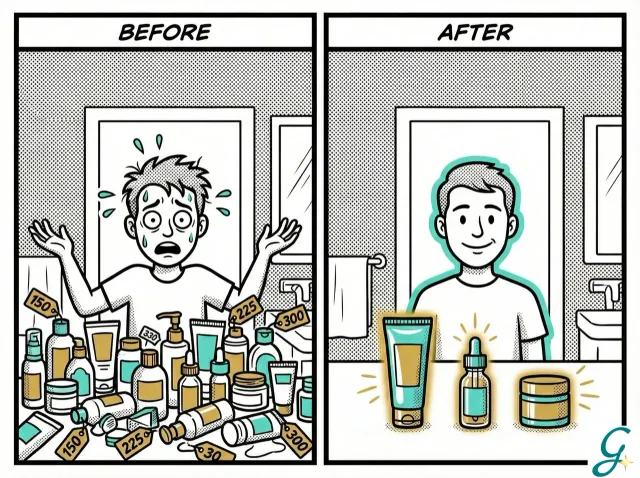
- You don't need 10 products — 3-4 is enough for most people
- Expensive doesn't mean better — Effective products exist at every price point
- Results take time — Expect 4-8 weeks for visible changes
- Consistency beats complexity — A simple routine you do daily beats an elaborate one you skip
Understanding Your Skin Type
Knowing your skin type helps you choose the right products.
How to Determine Your Skin Type
- Wash your face with a gentle cleanser
- Wait 1 hour without applying anything
- Observe your skin:
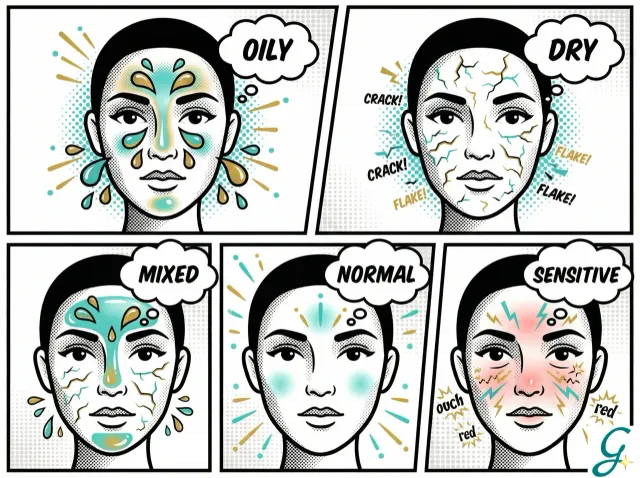
Oily Skin
- Shiny all over, especially T-zone
- Enlarged pores
- Prone to breakouts
Dry Skin
- Feels tight or rough
- May have flaky patches
- Rarely gets shiny
Combination Skin
- Oily T-zone (forehead, nose, chin)
- Normal to dry cheeks
- Most common skin type
Normal Skin
- Balanced, not too oily or dry
- Few breakouts
- Small pores
Sensitive Skin
- Reacts easily to products
- Prone to redness, stinging, or irritation
- May have conditions like rosacea or eczema
The Beginner's Skincare Checklist
Essential Products (Start Here)
| Product | Purpose | When to Use |
|---|---|---|
| Cleanser | Remove dirt, oil, makeup | Morning & evening |
| Moisturizer | Hydrate and protect skin | Morning & evening |
| Sunscreen | Prevent sun damage and aging | Every morning |
That's your starter kit. Master these three before adding anything else.
Optional Additions (After 4-6 Weeks)
| Product | Purpose | When to Use |
|---|---|---|
| Exfoliant | Remove dead skin, improve texture | 2-3x per week, evening |
| Serum | Target specific concerns | Morning or evening |
| Eye cream | Address under-eye concerns | Morning & evening |
Your First Skincare Routine
Morning Routine (3 minutes)
Step 1: Cleanse
- Wet face with lukewarm water
- Apply cleanser, massage gently for 30-60 seconds
- Rinse thoroughly, pat dry
Step 2: Moisturize
- Apply to slightly damp skin
- Use upward motions
- Don't forget your neck
Step 3: Sunscreen
- Apply generously (about 1/4 teaspoon for face)
- Wait 1-2 minutes before makeup
- This is the most important step for preventing aging
Evening Routine (3 minutes)
Step 1: Cleanse
- Remove makeup and sunscreen
- If you wear heavy makeup, consider double cleansing (oil cleanser first, then regular cleanser)
Step 2: Moisturize
- Can use a slightly richer formula at night
- Your skin repairs while you sleep
Choosing Your First Products
Cleanser
For oily skin: Gel or foaming cleanser For dry skin: Cream or milk cleanser For sensitive skin: Fragrance-free, gentle formula For all skin: Avoid harsh sulfates (SLS, SLES)
Moisturizer
For oily skin: Lightweight gel or lotion For dry skin: Rich cream with ceramides For sensitive skin: Fragrance-free, minimal ingredients For all skin: Look for hyaluronic acid, glycerin, or ceramides
Sunscreen
For oily skin: Mattifying, oil-free formula For dry skin: Hydrating formula For sensitive skin: Mineral sunscreen (zinc oxide, titanium dioxide) For all skin: SPF 30+ broad-spectrum
Common Beginner Mistakes
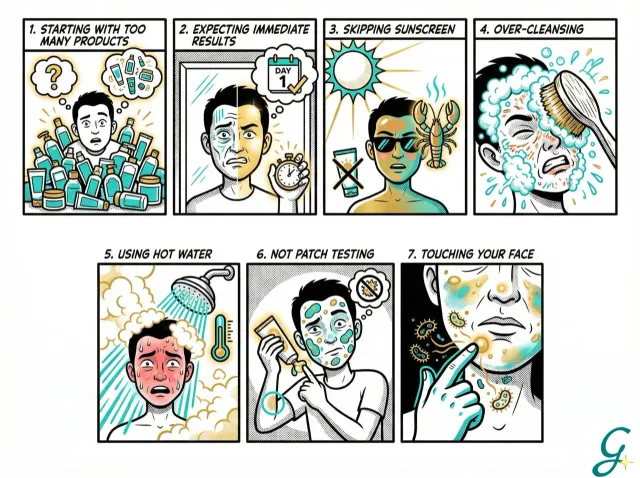
1. Starting with Too Many Products
Your skin needs time to adjust. Start with the basics and add one new product at a time, waiting 2 weeks between additions.
2. Expecting Immediate Results
Skincare is a long game. Most products need 4-8 weeks to show results. Be patient.
3. Skipping Sunscreen
UV damage causes 90% of visible aging. Even if you're young, daily sunscreen prevents future damage.
4. Over-Cleansing
Washing your face more than twice daily strips natural oils and damages your skin barrier.
5. Using Hot Water
Hot water is too harsh. Use lukewarm water to cleanse.
6. Not Patch Testing
New products can cause reactions. Test on a small area (inner arm or behind ear) for 24-48 hours first.
7. Touching Your Face
Your hands transfer bacteria and oil. Keep hands away from your face.
Understanding Key Ingredients
You don't need to be a chemist, but knowing a few key ingredients helps:
Hydrating Ingredients
- Hyaluronic Acid — Holds water in skin, plumping effect
- Glycerin — Draws moisture to skin
- Ceramides — Strengthen skin barrier
Exfoliating Ingredients
- AHAs (Glycolic, Lactic Acid) — Surface exfoliation, brightening
- BHAs (Salicylic Acid) — Penetrates pores, good for oily/acne skin
Anti-Aging Ingredients
- Retinol — Increases cell turnover, reduces wrinkles
- Vitamin C — Antioxidant, brightening
- Niacinamide — Versatile, reduces pores and redness
Ingredients to Avoid (Especially for Beginners)
- Fragrance — Common irritant
- Alcohol (denat.) — Drying
- Essential oils — Can irritate sensitive skin
Building Your Routine Over Time
Month 1-2: Master the Basics
- Cleanser, moisturizer, sunscreen
- Focus on consistency
- Learn how your skin responds
Month 3-4: Add One Treatment
Based on your main concern:
- Acne: Salicylic acid cleanser or treatment
- Dullness: Vitamin C serum
- Texture: AHA exfoliant (2x/week)
- Anti-aging: Retinol (start low, go slow)
Month 5+: Refine and Adjust
- Evaluate what's working
- Adjust products seasonally
- Add or remove based on skin's needs
When to See a Dermatologist
Some concerns need professional help:
- Severe or persistent acne
- Suspected skin conditions (eczema, rosacea, psoriasis)
- Unusual moles or spots
- Reactions that don't resolve
- Prescription-strength treatments
Don't be afraid to seek professional advice—dermatologists can save you time and money in the long run.
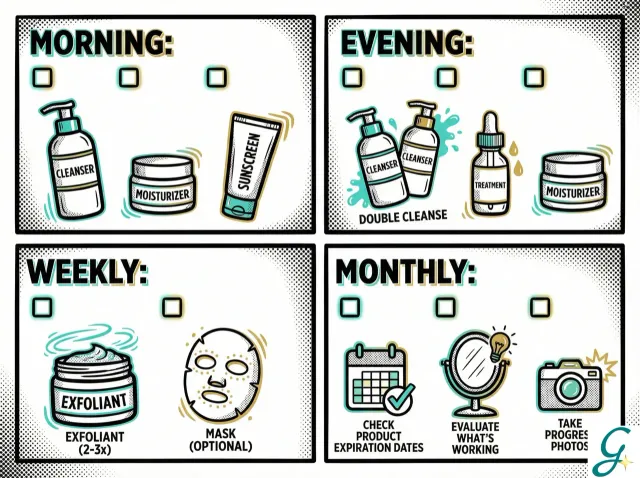
Skincare Routine Checklist
Print this or save it:
Morning:
- Cleanser
- Moisturizer
- Sunscreen
Evening:
- Cleanser (double cleanse if wearing makeup/SPF)
- Treatment (if using)
- Moisturizer
Weekly:
- Exfoliant (2-3x)
- Mask (optional)
Monthly:
- Check product expiration dates
- Evaluate what's working
- Take progress photos
Frequently Asked Questions
What is a good skincare routine for beginners?
A beginner routine needs just three products: gentle cleanser, moisturizer, and sunscreen (morning). At night: cleanser and moisturizer. This covers the essentials—clean skin, hydration, and sun protection. Master these for 1-2 months before adding treatments.
What order do you apply skincare products?
Apply products from thinnest to thickest: cleanser → toner (optional) → serum → eye cream → moisturizer → sunscreen (morning only). At night, skip sunscreen and add treatments like retinol after cleansing. Water-based products go before oil-based.
How long does it take to see skincare results?
Basic improvements (hydration, less irritation) appear in 1-2 weeks. Visible changes in texture and tone take 4-6 weeks (one skin cell cycle). Significant results for concerns like acne, pigmentation, or anti-aging take 2-3 months of consistent use.
What skincare ingredients should beginners avoid?
Beginners should initially avoid strong actives like high-concentration retinoids, strong AHAs/BHAs, and vitamin C above 10%. Also avoid fragrance and essential oils if you have sensitive skin. Start with gentle, basic products and add actives gradually after your skin adjusts.
How do I know my skin type?
Wash your face, wait 1 hour without applying products, then observe: Oily all over = oily skin. Tight and flaky = dry skin. Oily T-zone but dry cheeks = combination. Easily irritated with redness = sensitive. Normal skin feels balanced without excess oil or dryness.
Do I need a toner?
Toners are optional for beginners. Modern cleansers are pH-balanced, making toners less necessary than in the past. If you want to add one, choose hydrating toners with hyaluronic acid or niacinamide rather than astringent alcohol-based formulas.
Track Your Skincare Journey
Starting skincare is exciting, but staying consistent is the challenge. Tracking helps you:
- Build the daily habit
- Remember your routine
- See progress over time
- Know what products work for you
Glimmer is designed for skincare beginners and enthusiasts alike. Set up your simple routine, get gentle reminders, and track your skin's progress.
Sources
- Draelos, Z. D. (2018). "The science behind skin care: Cleansers." Journal of Cosmetic Dermatology, 17(1), 8-14.
- Rawlings, A. V., & Harding, C. R. (2004). "Moisturization and skin barrier function." Dermatologic Therapy, 17(s1), 43-48.
- Lim, H. W., et al. (2017). "Sunscreen FAQ: A review of the 2016 Food and Drug Administration proposed rulemaking on sunscreen drug products." Journal of the American Academy of Dermatology, 76(5), 958-964.